

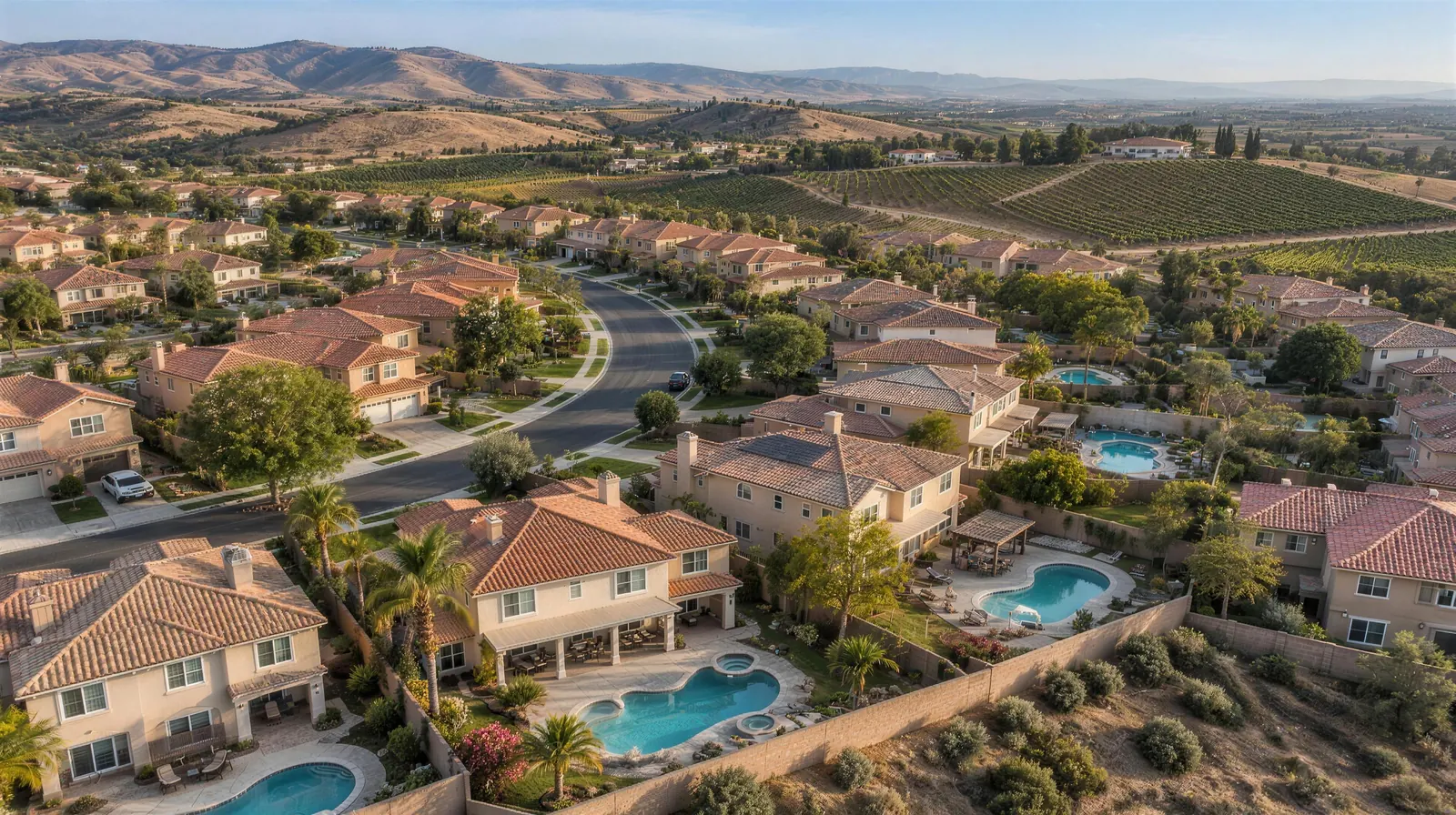
A lot of Temecula Valley homes sit in master-planned communities with homeowners associations. If yours does, the HOA's architectural committee will want to approve your pool before it's built. Here's how that review usually works and how to get through it without losing weeks.
Many neighborhoods across Temecula and Murrieta have associations, including communities like Redhawk, Harveston, Wolf Creek and Paloma del Sol, and much of the newer construction in Menifee and Lake Elsinore does too. Every association writes its own rules, so treat this guide as a map of the process, not a substitute for your own CC&Rs and architectural guidelines.
Step 1: Find your rules
Start with three documents: your CC&Rs (the recorded covenants), the architectural or design guidelines, and the application form. Your HOA's management company or member portal usually has all three. Look for anything about pools, spas, equipment placement, noise, setbacks from walls, drainage, fencing, and construction access and hours.
Step 2: Know what the committee looks at
Architectural review committees are mostly concerned with how the project affects the neighborhood and the association's property. Common topics include:
- Where the equipment pad goes, and how pump and heater noise is handled. Variable-speed pumps are quieter, which helps.
- Distance from shared block walls and property lines, and whether excavation could affect a wall.
- Drainage, so pool and deck water doesn't run onto a neighbor's lot or the street.
- Visible features above the wall line, such as raised spas, waterfalls, slides or shade structures.
- Construction access, especially if equipment has to cross common areas or a neighbor's lot.
- Landscaping and hardscape changes that are part of the project.
Step 3: Put together a clean application
Incomplete applications are the most common cause of delay. A typical pool submittal includes:
- The HOA's application form, signed by the owner.
- A site plan showing the pool, spa, decking, equipment pad and their distances to walls and property lines.
- Elevations or a sketch of anything that rises above the wall, like a raised spa or waterfall.
- Materials and colors for decking, coping and any walls.
- The contractor's name, license number and proof of insurance, if the HOA asks.
- Neighbor acknowledgment or notice, if your association requires it.
Your builder should provide the drawings. A site plan from the 3D designer is a useful starting point for the conversation, but the HOA will expect the builder's scaled plan.
Step 4: Submit early and track the clock
Committees often meet monthly, so missing a meeting can cost several weeks. Submit as soon as your design is settled, ask when the next review meeting is, and ask whether a complete application can be reviewed at that meeting. Keep a copy of everything you submit and note the date.
Your rights under California law
Most California HOAs are governed by the Davis-Stirling Common Interest Development Act. For architectural review, the Civil Code requires the association's decision to be made in good faith and not be unreasonable, arbitrary or capricious; to be in writing; and, if your application is denied, to explain why and describe how to request reconsideration. The details are in Civil Code section 4765. If you run into a dispute, read your governing documents and that section, and consider talking to a professional before construction starts.
HOA approval and the city permit
HOA approval and the building permit are separate. The association approves the project under the CC&Rs; the city or county approves the construction under the building code. Many builders wait for HOA approval before submitting to the city so they don't have to revise plans twice. Our guide to pool permits in Riverside County covers the city side.
If your application comes back with changes
Conditional approvals are common. A committee might approve the pool but ask you to move the equipment pad farther from a shared wall, add a sound enclosure, lower a waterfall, or change a deck color. Ask for the conditions in writing, have your builder update the plan, and resubmit if required. If a condition doesn't make sense for your lot, the reconsideration process is the place to explain why, ideally with your builder's help.
Keep the approval letter with your permit and plans. If you sell the house, a buyer's inspector or the next owner's HOA review may ask for proof that the pool was approved.
Remodels need approval too, sometimes
A like-for-like replaster usually doesn't change anything the HOA cares about, but adding a spa, a waterfall, a shade structure or moving equipment often does. If in doubt, ask the management company before work starts; asking is free, and undoing work is not.
Free 3D designer. Estimate before you share your number.
How we help
When you book a free consultation, the licensed partner builder prepares the plans the HOA and the city need, and we help you keep track of where each approval stands. If you're in Temecula, our Temecula service area page has local notes on HOAs and permits, and our new pools page explains the whole process from design to first swim.
By the Coastline Pools team · Published November 12, 2026 · Last reviewed November 12, 2026. General information, not legal or financial advice.