

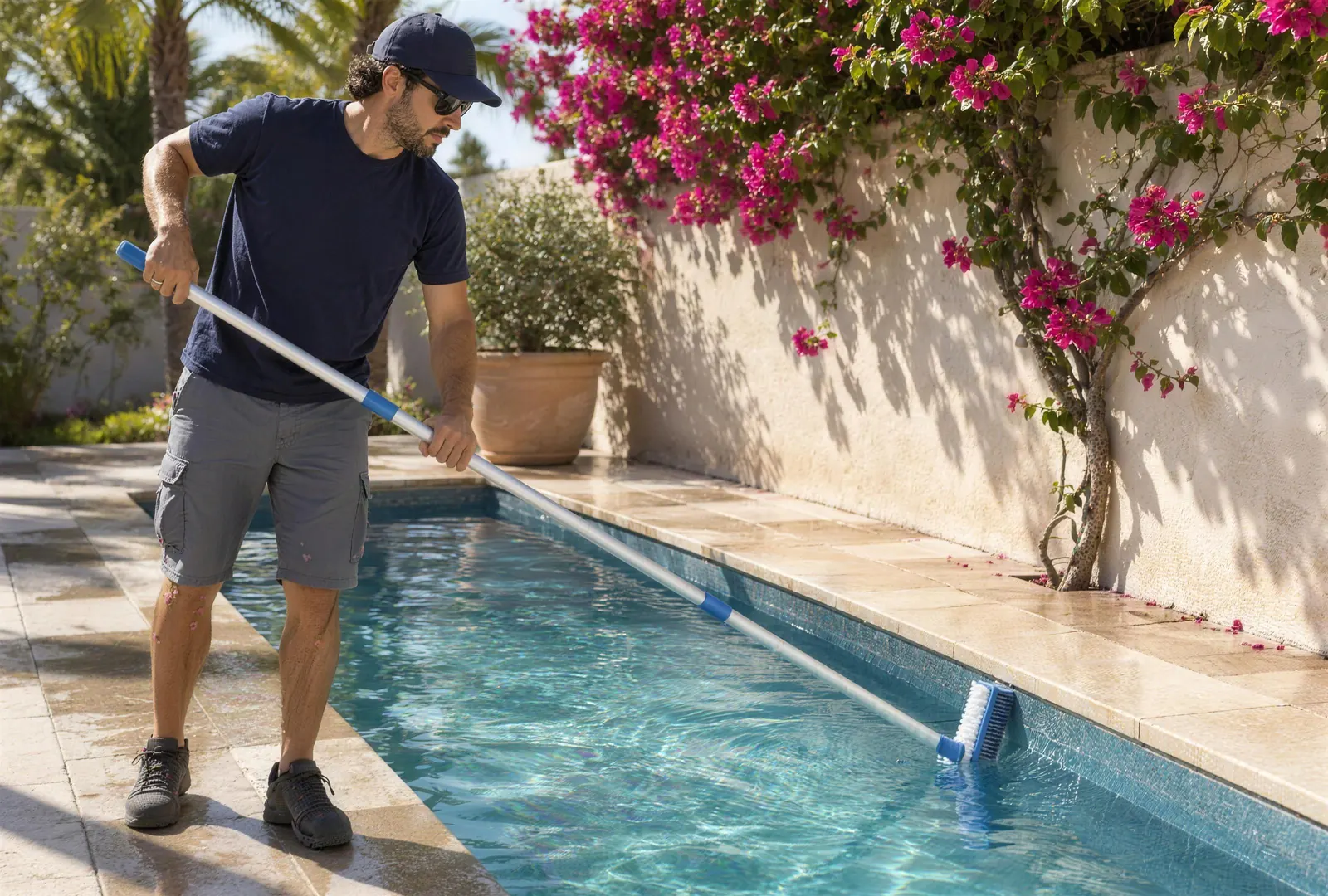
Weekly pool cleaning in Southern California.
Skim, brush, vacuum and balanced water every week, then a photo report. Month to month, chemicals included. Weekly service routes start in the Inland Empire; elsewhere we match you with a vetted local pro.
What's your monthly price?
Enter your address and answer 3 quick questions. See your price before you give us your number.
Two plans. Weekly service, chemicals included.
Starting prices for weekly service. Spa and large pools add a set amount, listed below.
Cleaning & Maintenance
- Weekly visit: skim, brush, vacuum
- Empty skimmer & pump baskets
- Test and balance the water
- All chemicals included
- Photo report after every visit
Full Equipment & Care
- Everything in Cleaning & Maintenance
- 3 filter cleans per year
- Quarterly salt cell clean (salt pools)
- Equipment check every visit
- Minor equipment service
- Priority repair response within 48 hours
- Spa on shared equipment+$39/mo
- Spa on separate equipment+$59/mo
- Large pool (over ~20,000 gallons)+$45/mo
- Cartridge filter clean$145
- DE filter clean$185
- Salt cell clean$89
- Green pool cleanup$385–$695
- One-time cleanfrom $169
- Drain, acid wash & refillfrom $849
All chemicals included · Photo report after every visit · No long-term contract · Cancel anytime.
What a visit includes.
Southern California sun burns through chlorine and dry winds fill skimmers. A proper weekly visit handles both, and catches equipment problems early.
- Water chemistryTest and balance chlorine, pH, alkalinity and stabilizer, and watch calcium. Local water is hard, so scale prevention matters.
- CleanSkim the surface, brush walls, steps and the tile line, vacuum the floor, empty skimmer and pump baskets.
- CheckA look at the pump, filter pressure and leaks every visit.
- ReportA text with a photo and anything we noticed. No guessing whether we came.
SoCal sun changes pool care.
Inland pools, from the Inland Empire to the valleys of LA and San Diego counties, run warmer and get more sun than pools right on the coast. Warm water and strong sun use up chlorine quickly, so a pool that's balanced on Monday can be struggling by Friday in July. Weekly visits keep chlorine and stabilizer where they need to be instead of swinging between too much and too little.
The other local factor is debris. Santa Ana wind days, palm fronds, oak leaves and construction dust in newer neighborhoods all end up in the skimmer and the filter. Brushing, vacuuming and emptying baskets every week keeps that from turning into algae, and keeps the pump from running dry against a clogged basket.
Finally, tap water in much of Southern California tends to be hard. Over time that shows up as white scale on the tile line and rough plaster. Watching calcium and pH as part of every visit is the cheapest way to protect the surface, and it's why our notes mention scale before it becomes a resurfacing job.
- Salt poolsWe service salt systems too. Full Equipment & Care includes a quarterly salt cell clean; on Cleaning & Maintenance it's $89 when needed.
- SpasSpas are cleaned and balanced on the same visit: +$39/mo on shared equipment, +$59/mo on separate equipment.
- Vacation holdsGoing away? We keep the visit and send the photo, so you come back to a clear pool.
- First visitWe start with a free first look: water test, equipment check and a confirmed monthly price.
What happens on each weekly visit.
The same steps, in the same order, every week. Then a photo report so you know it happened.
- Arrive and check the gateWe let ourselves in with the access you set up, latch the gate behind us and note anything off, like a sprinkler head spraying the deck or a dog left out.
- Look before touching anythingA quick read of the water level, clarity and the pump's sound tells us whether this is a routine visit or one that needs extra attention.
- Skim the surfaceFloating leaves, bugs and blossoms come out with a leaf net before they sink and start to break down.
- Brush walls, steps and tileBrushing loosens film and early algae from corners, benches and the waterline so the filter can catch it.
- Vacuum the floorWe vacuum what settled, or check that your automatic cleaner is moving freely and its bag or canister is empty.
- Empty the basketsSkimmer and pump baskets get emptied every week so the pump never strains against a clogged basket.
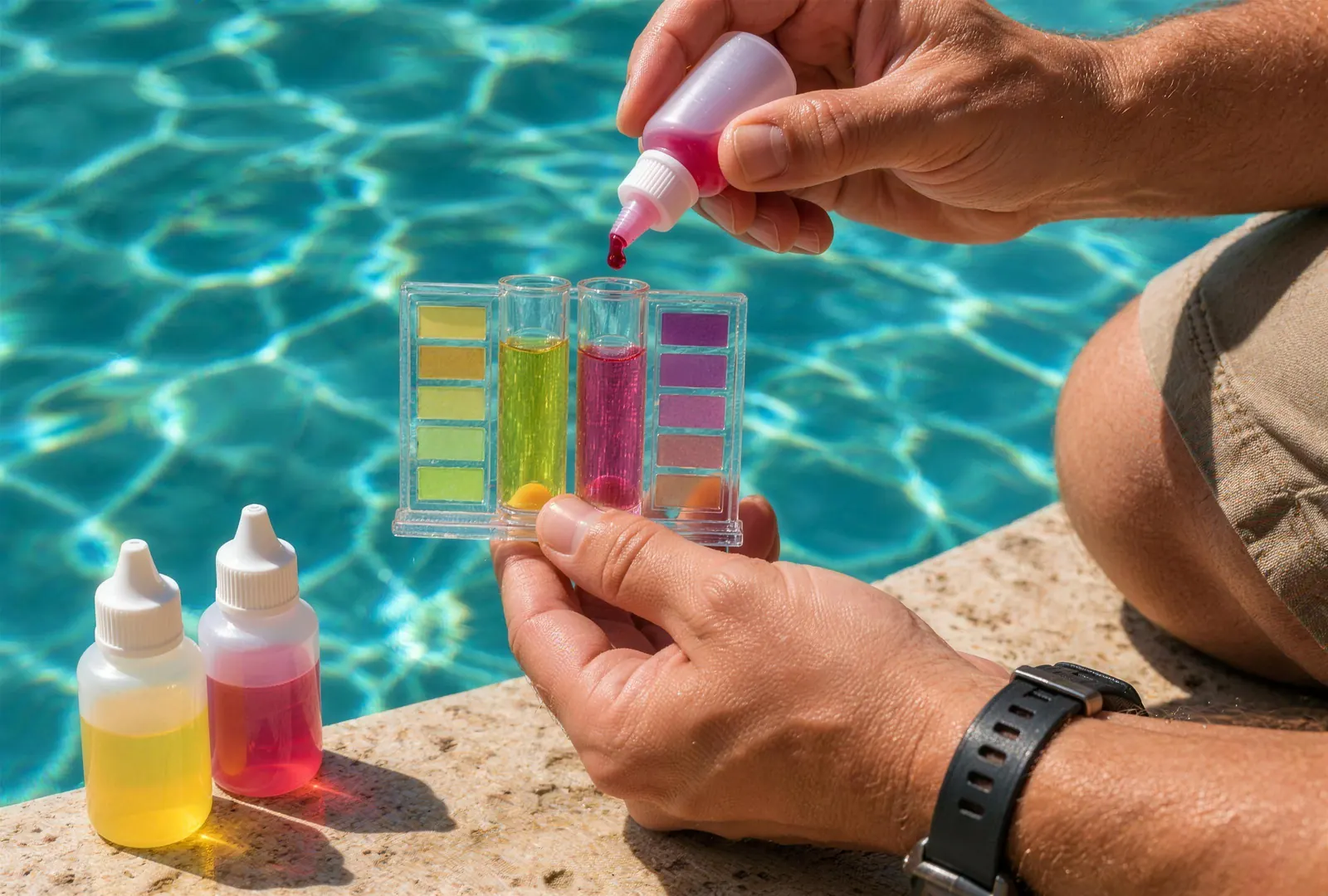
- Test the waterWe test chlorine, pH, alkalinity and stabilizer each visit, and check calcium and salt on a regular schedule.
- Dose and adjustChemicals go in based on the test, not a fixed recipe, and the water level gets topped off if it has dropped.
- Equipment check and photo reportWe glance at filter pressure, the pump and the plumbing for leaks, then text you a photo of the finished pool with a note on anything we saw.
What we test, and why it drifts here.
Clear water isn't always balanced water. Slow drift in pH or stabilizer is what leads to cloudy weeks, scale and early plaster wear. Here is what we track, with commonly published targets for a residential plaster pool.
These readings affect each other, so each visit starts with a test and ends with small corrections rather than big doses. A reading that keeps drifting usually points to something else, like a leak or a failing cell, and we'll say so in the visit report.
- Free chlorineThe sanitizer that keeps algae and bacteria in check. Sun and warm water use it up, so a July pool burns through in days what lasts a week in March. The right level depends on stabilizer: more stabilizer means more chlorine is needed.
- pHAbout 7.4 to 7.6. Chlorine works poorly when pH runs high, and salt pools and fresh plaster both push it upward.
- Total alkalinityAbout 80 to 120 ppm. It buffers pH so it doesn't bounce after rain or a chemical dose.
- Cyanuric acid (stabilizer)It shields chlorine from the sun. About 30 to 50 ppm is typical for chlorine pools. It only leaves with drained or splashed water, so tablets can build it up over a summer until chlorine struggles.
- Calcium hardnessRoughly 200 to 400 ppm for plaster. Much of the region's water is hard and evaporation concentrates it, so the usual problem here is too much, seen as white scale at the tile line.
- Salt (salt pools)A salt cell makes chlorine from dissolved salt. We follow the range your cell's manufacturer lists rather than a general number. Low salt or scaled plates cut its output.
Seasonal pool care by region.
Southern California isn't one climate. Here's what each season tends to do to a pool in each region we serve.
The Inland Empire
- SpringPollen and blossoms coat the surface and load the filter, and the first warm weeks wake up any algae that sat dormant over winter.
- SummerThis is the hard stretch. Triple-digit afternoons, strong sun and heavy swimming push chlorine demand up and water levels down, so balance and top-offs need attention every week.
- FallSanta Ana winds can dump dust and leaves into a pool overnight. Water is still warm, so chlorine demand stays high longer than most people expect.
- WinterCooler water slows algae and chemical use. Rain dilutes the pool and washes in planter soil, and some nights get cold enough that freeze protection on the equipment matters.
Orange County
- SpringNear the coast, May gray and June gloom keep water cooler and chlorine use modest. Jacaranda and other flowering trees start dropping petals that stain if left on the floor.
- SummerOnce the marine layer burns off, demand rises, especially in the canyons and inland cities, where afternoons run noticeably hotter than at the beach.
- FallSanta Ana winds push down the canyons and across the foothill neighborhoods, bringing dry leaves and fine dust. In some years there is ash too.
- WinterRain is the main event: runoff from slopes and planters, more leaves and a drop in chlorine as the water dilutes.
San Diego County
- SpringCoastal pools sit under morning overcast for weeks, while inland North County warms up early. Pollen and jacaranda blooms are common in both.
- SummerThe split widens. Coastal water stays mild, but inland valleys around Escondido and Poway get real heat, and those pools need closer chlorine and stabilizer watch.
- FallDry offshore winds bring dust, leaves and fire weather. Canyon-edge lots tend to catch the most debris.
- WinterStorms are fewer than in many places, but when they come they wash mulch and soil from slopes into the water.
Los Angeles County
- SpringSycamores, oaks and flowering street trees shed pollen and seed pods, and the filter takes the brunt of it.
- SummerValley pools in the San Fernando, San Gabriel and Santa Clarita areas run hot for months, so chlorine demand is steady and high. South Bay pools stay much milder.
- FallSanta Ana winds through the passes and canyons bring leaves, dust and sometimes ash. Older pools with tired filters feel it first.
- WinterRain and leaf drop slow things down. In the Antelope Valley, freezing nights are common, so freeze protection on the pump matters.
No contracts. Cancel anytime.
We keep customers by doing the work, not by locking them in. Month to month, all chemicals included, and a photo report after every visit.
Pool cleaning questions.
Didn't find yours? Send us a message or email [email protected]. A real person answers.
How much does weekly pool cleaning cost?
Is there a contract?
Do I need to be home?
What's included in a visit?
Do you service spas and saltwater pools?
Green pool or broken pump? Repairs are handled by our licensed partner contractors. Request a repair